FORMAT
offline, Kyiv
10 Dobrovolchykh batalyoniv St.
MENTOR
Volodymyr Shelukhin
FORMAT
offline, Kyiv
10 Dobrovolchykh batalyoniv St.
MENTOR
Volodymyr Shelukhin
 Today, racial “theories” are considered unscientific. But at the time of their emergence in the nineteenth century, they were associated with positive science and its most recent achievements. Racial “theorists” used the ideas of leading researchers in the natural sciences and humanities, from Darwin’s evolutionary theory to Mueller’s comparative studies of religion. “Scientific racism” was the essence of science in the late nineteenth century.
Ukrainian intellectuals-artists and sociologists-could not stay away from the influence of the concepts that were sweeping Europe. However, their acquaintance with them had quite unexpected consequences compared to those in Germany or some other European countries. The “harmful” concept was used for the purposes of liberation and eventually brought to its negation.
The experience of perceiving racial concepts is a fascinating intellectual journey into the wilds of human thought, which shows that the history of social ideas has a much more complex trajectory than is commonly thought. And this experience can serve as a warning for us today in the age of techno-fundamentalism, a belief in the limitless possibilities of technology that has replaced “racial concepts” on the pedestal of modern scholarship.
This page of the history of social thought is extremely poorly studied, its content is known only to a very narrow circle of specialists. Today, “racial theories” are part of the past of social thought, but they have been replaced on the pedestal of scholarship by new gods in the form of techno-fundamentalism, whose reception today is surprisingly consistent with how much faith was placed in the discovery of the power of “race” at the turn of the XIX-XX centuries. So perhaps this forgotten history can be instructive for us today.
Volodymyr Shelukhin
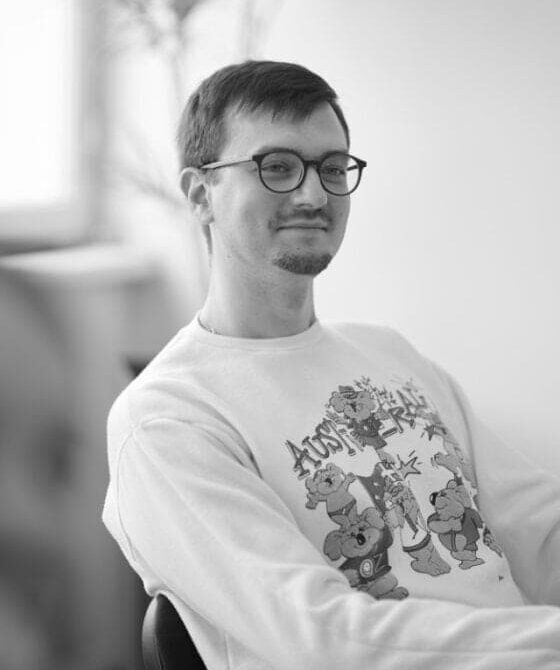
Volodymyr Shelukhin
Sociologist, PhD in Sociology, Lecturer at the Faculty of Sociology at Taras Shevchenko National University of Kyiv and the Locus educational project, Guest Professor at Kyiv Mohyla Business School.
He has taught courses on the social structure of society, socio-political studies, welfare policy, and cultural studies.
Deep understanding of the history of social ideas and their impact on nation-building
Rethinking “racial” theories
Past experience in the projection of modern social engineering
Kyiv, 10 Dobrovolchykh batalyoniv St.